Tampa Bay · 2026 Turf Cost Guide
How much does artificial turf cost in Tampa Bay?
Average install $4,200–$6,000 · Average cost per sq ft $7–$10
FREE Premium Limestone Base Upgrade, a $1,500 upgrade most installers charge extra for. Better drainage, a base that won't settle, fewer pet odors.
✓ Real installer pricing✓ Bonded & insured✓ Free on-site measurement
How much does it cost to install artificial turf?
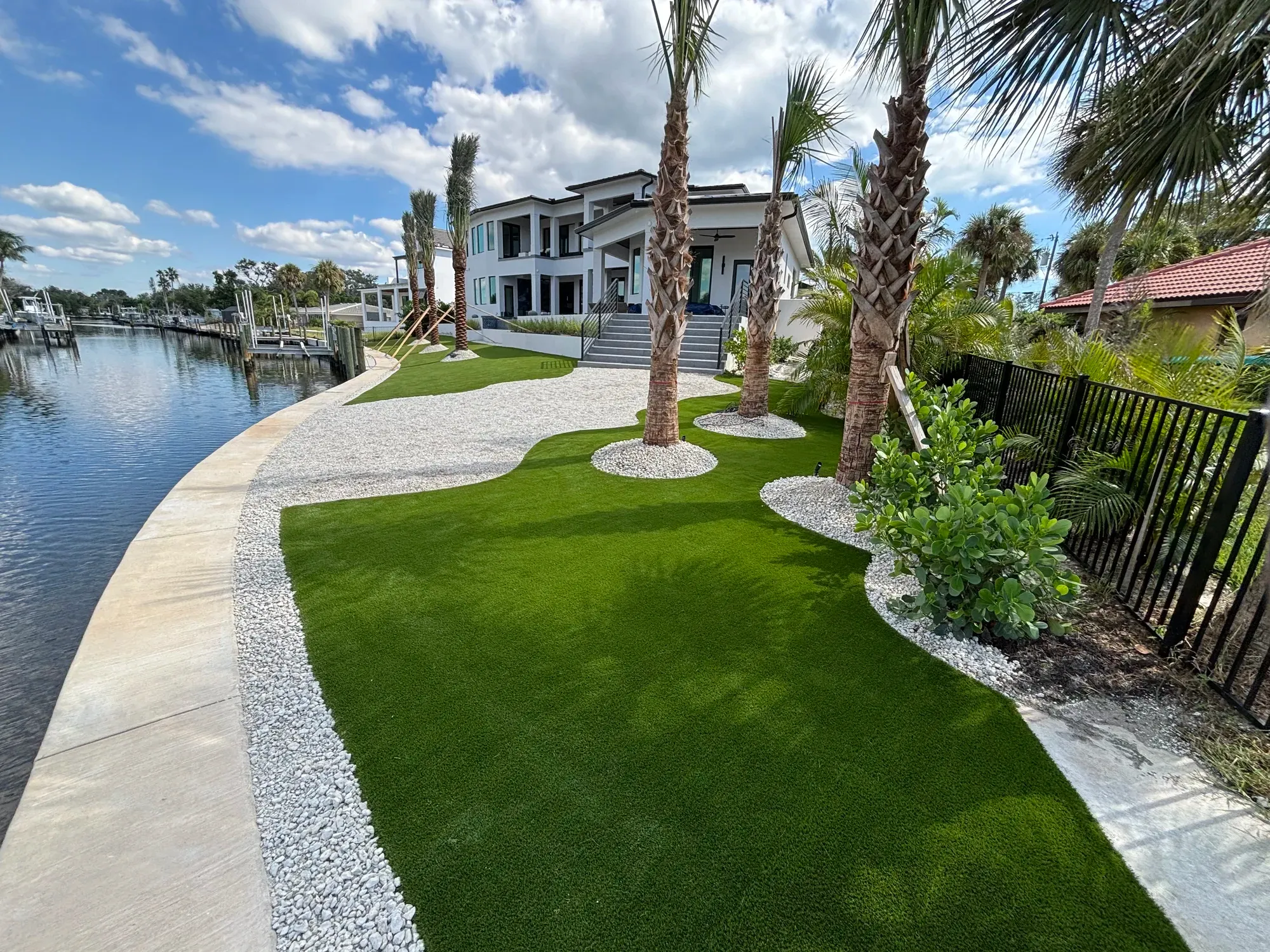
It costs $4,200 to $6,000 to install artificial turf on a typical 600 sq ft Tampa Bay backyard, or $7–$10 per square foot installed. That price is a complete job: the existing sod stripped and hauled away, a compacted limestone base built underneath, and the turf seamed, fastened and infilled.
Where you land inside that range comes down to five things: how much turf you need, how easy your yard is to get equipment into, what has to come out first, the grade of turf you pick, and how much drainage work the site needs. Every one of those is broken down below.
Artificial turf cost by project type
Four jobs, four very different price structures. These are the ranges our vetted Tampa Bay installer quotes in 2026 — not national averages, and not a teaser rate that climbs once someone is standing in your yard.
| Project | Cost per sq ft | Typical total* |
|---|---|---|
| Artificial turf installation | $7–$10 | $4,200–$6,000 |
| Putting green | $12–$15 | $7,200–$9,000 |
| Artificial turf repair | $5–$8 | $3,000–$4,800 |
| Pet turf repair & restoration | $7–$10 | $4,200–$6,000 |
*Based on a 600 sq ft project. Jobs under $1,500 price off our minimum — see cost by yard size.
Turf installation
$7–$10 /sq ft
A full tear-out and rebuild: existing sod removed and hauled off, base built and compacted, turf seamed, fastened and infilled.
Putting green
$12–$15 /sq ft
Costs more because of the base, not the turf. The surface has to be graded to a far tighter tolerance than a lawn, then contoured, cupped and top-dressed to roll true.
Turf repair
$5–$8 /sq ft
Seams, tears, wrinkles, low spots and drainage. Priced over the affected area, not the whole yard, so most repairs are a fraction of a replacement.
Pet turf repair
$7–$10 /sq ft
Prices like an install, not a repair. Urine saturates the infill and the base beneath it, so the fix is lifting the turf, replacing infill, treating the base and re-laying.
Why pet turf "repair" costs the same as a new install
This is the number that surprises people, so it's worth saying plainly. A urine-damaged yard is not a turf problem — the turf is usually fine. The urine has soaked past the blades into the sand infill, which holds it, and down into the base, where Florida humidity keeps reactivating it. Rinsing the surface does nothing. The actual fix is lifting the turf, stripping and replacing every bit of infill, treating or rebuilding the base, and re-laying on a fully permeable backing. That is install labor, so it prices like an install — $7–$10 per square foot — rather than at the $5–$8 repair rate.
Artificial turf cost by yard size
Turf is sold and installed by the square foot, so total cost tracks area almost linearly. The one place it stops being linear is at the small end: a crew still has to mobilize, haul equipment in and dispose of spoil for a 150 sq ft side yard, so small jobs price off a $1,500 minimum rather than off the per-square-foot rate.
| Yard size | Turf installation | Effective $/sq ft | As a putting green |
|---|---|---|---|
| 200 sq ft | $1,500–$2,000 | $7.50–$10 | $2,400–$3,000 |
| 400 sq ft | $2,800–$4,000 | $7–$10 | $4,800–$6,000 |
| 600 sq ft | $4,200–$6,000 | $7–$10 | $7,200–$9,000 |
| 800 sq ft | $5,600–$8,000 | $7–$10 | $9,600–$12,000 |
| 1,000 sq ft | $7,000–$10,000 | $7–$10 | $12,000–$15,000 |
| 1,200 sq ft | $8,400–$12,000 | $7–$10 | $14,400–$18,000 |
| 1,400 sq ft | $9,800–$14,000 | $7–$10 | $16,800–$21,000 |
| 1,600 sq ft | $11,200–$16,000 | $7–$10 | $19,200–$24,000 |
| 1,800 sq ft | $12,600–$18,000 | $7–$10 | $21,600–$27,000 |
| 2,000 sq ft | $14,000–$20,000 | $7–$10 | $24,000–$30,000 |
| 2,400 sq ft | $16,800–$24,000 | $7–$10 | $28,800–$36,000 |
| 3,000 sq ft | $21,000–$30,000 | $7–$10 | $36,000–$45,000 |
Installation at $7–$10/sq ft and putting greens at $12–$15/sq ft, with the $1,500 minimum applied. Removal of what's there now is priced separately — see sod removal & haul-off.
Notice the effective rate falling as the yard gets bigger. That is real, and it is worth knowing before you shrink a project to save money: cutting a 1,000 sq ft plan down to 600 sq ft does not cut the price by 40%, because mobilization, equipment and disposal barely move. If you are close to a size threshold, ask what the next 200 sq ft actually costs — it is usually the cheapest turf you will ever buy.
Where the money actually goes
Most quotes give you one number. Here is what that number is made of on a $7–$10 per square foot install, so you can tell the difference between a bid that is cheap and a bid that is missing something.
| Line item | Per sq ft | On 600 sq ft |
|---|---|---|
| Turf material | $2–$4.50 | $1,200–$2,700 |
| Base aggregate + delivery | $1.50–$2.50 | $900–$1,500 |
| Excavation + haul-off | $1–$1.75 | $600–$1,050 |
| Labor | $2–$3 | $1,200–$1,800 |
| Infill | $0.35–$0.90 | $210–$540 |
| Edging, fasteners & seaming | $0.30–$0.60 | $180–$360 |
These ranges overlap the $7–$10 total rather than summing to it exactly. Every yard weights them differently — a hard-access backyard shifts cost into labor, a premium turf shifts it into material — and a breakdown that adds up too neatly is a breakdown someone reverse-engineered.
Read this before you compare bids
A bid comes in $3 a foot under everyone else. Where did it go?
Turf material and labor are close to fixed — nobody is buying turf meaningfully cheaper than anyone else in this market, and nobody is paying a crew half rate. So a bid that is dramatically low almost always took it out of the same three places:
✓
Base depth. Two inches of aggregate instead of four. Invisible on day one, and the single most common cause of the wrinkles and low spots we get called out to fix.
✓
Separation fabric. Skipping the geotextile layer between native soil and base. In Tampa Bay sand, that fabric is the only thing keeping your base from slowly sinking into the ground.
✓
Infill volume. "Infill included" without a quantity. Under-filled turf mats within two seasons and cannot be brushed back.
Turf material
$2–$4.50 / sq ft
The single biggest variable on the page. Face weight and backing construction drive it — a 50 oz builder-grade turf and a 90 oz premium with a fully permeable backing are the same product category and nearly double the price.
Base aggregate + delivery
$1.50–$2.50 / sq ft
Crushed limestone or recycled concrete, 3–4" compacted, plus the geotextile separation fabric under it. Priced by the ton delivered, so haul distance from the pit shows up here.
Excavation + haul-off
$1–$1.75 / sq ft
Stripping 3–4" of existing sod and soil and paying to dispose of it. Backyard-only gate access means everything moves by wheelbarrow, which is why access is one of the biggest swing factors in a bid.
Labor
$2–$3 / sq ft
Grading, compacting in lifts, cutting, seaming, fastening and brushing. This is where crew skill lives, and where the difference between two bids usually actually is.
Infill
$0.35–$0.90 / sq ft
Rounded silica sand on a standard lawn; antimicrobial or zeolite infill where pets are involved. It is not optional — infill is what holds the blades upright and keeps the turf from matting.
Edging, fasteners & seaming
$0.30–$0.60 / sq ft
Bender board or steel edging, nails and staples, seam tape and adhesive. Small line item, but skipped edging is why turf perimeters lift.
Labor: roughly a third of your bill
On a typical Tampa Bay install, labor runs $2.00–$3.00 per square foot — about a third of the total. It is also the line item you cannot inspect after the fact, which is why it is worth understanding what a crew is actually doing out there. Five stages, in order:
1
Excavation & grading
Three to four inches of sod and soil come out, and the subgrade gets shaped to fall away from the house at roughly 1–2%. Get the fall wrong here and no amount of drainage hardware fixes it later.
2
Base placement & compaction
Aggregate goes down in lifts of about two inches, each one wetted and compacted before the next. This is the step that gets rushed, because a plate compactor pass looks the same whether the crew did it once or three times.
3
Cutting & seaming
Turf is directional — every piece has to run the same way or the yard changes color as you walk around it. Seams are glued and nailed on tape, not just stapled at the edges.
4
Fastening & edging
Perimeter nails every few inches into the compacted base, with bender board or steel edge where the turf meets beds or pavers.
5
Infill & brushing
Sand is dropped and power-broomed up through the fibers in passes. Done properly the blades stand up and the seams disappear; done in one pass the infill sits on top and the yard looks flat.
Access changes this number more than anything else. A front yard a crew can back a truck up to and a fenced backyard where every ton of base moves by wheelbarrow are the same square footage and not remotely the same job. If your only gate is three feet wide, say so when you ask for a quote — it is better priced in than discovered on install day.
Removing what's there now
Demolition and disposal are folded into our per-square-foot install price for a standard sod tear-out. They are broken out here because they are a real cost, and because a quote that looks unusually low is sometimes one that quietly excludes them.
| What comes out | Cost per sq ft | Notes |
|---|---|---|
| Live sod / lawn | $1–$1.75 | The usual case. Includes stripping 3–4" and disposal. |
| Failed artificial turf | $0.75–$1.50 | Faster to lift than sod, but the old infill has to be separated out and disposed of. |
| Mulch / rock beds | $0.60–$1.25 | Cheap to remove; landscape fabric underneath usually comes up with it. |
| Concrete or pavers | $3.50–$7 | Breaking, hauling and disposing of concrete is its own trade. Turf can often be laid over sound concrete instead, with a pad. |
Dump fees vary across Hillsborough, Pinellas and Pasco counties, and haul distance from your yard to the transfer station is part of this number.
One genuine money-saver: if you have sound concrete — an old patio, a slab, a walkway — turf can usually go straight over it with a drainage pad instead of being demolished. You keep the several dollars a foot that breaking and hauling concrete would have cost, and you get a slightly softer surface than the concrete alone. Ask about it before anyone quotes you demolition.
Types of artificial turf, and what each one is actually for
"Turf" is a category, not a product. The five below are built differently on purpose, and putting the wrong one in a yard is the most expensive mistake available to you — not because of the price difference, but because the replacement comes years early.
Landscape / lawn turf
1.5–1.75" pile $2.50–$4.00 / sq ft material
The default residential product and what most people picture. Polyethylene blades in mixed green tones with a tan thatch layer underneath so it does not read as a carpet. Best all-round balance of looking natural and standing up to being walked on.
Best for: Front yards, whole-lawn replacements, anywhere appearance matters most.
Pet turf
1–1.25" pile $3.00–$4.50 / sq ft material
Shorter and denser, on a fully permeable backing that drains across its entire surface rather than through punched holes. Paired with an antimicrobial or zeolite infill instead of plain silica sand. The short pile is the point: less fiber means less for urine to cling to and a surface you can actually rinse.
Best for: Dog runs, any yard with pets, side yards that take heavy traffic.
Play turf
1.25–1.75" pile + pad $3.00–$5.00 / sq ft material
Standard-looking turf installed over a closed-cell foam shock pad. The pad is what earns a certified fall-height rating under ASTM F1292 — the turf alone does not provide one, regardless of pile height.
Best for: Under playsets and trampolines, and anywhere a fall-height rating is required.
Putting green turf
0.5–0.75" pile $3.50–$5.50 / sq ft material
Nylon rather than polyethylene, cut very short and packed extremely dense, then heavily sand-filled so a ball rolls true instead of wobbling. Nylon is the stiffest and most heat-resilient of the three fibers, which is exactly why it works here and why it feels wrong underfoot on a lawn.
Best for: Practice greens and chipping areas. Usually paired with a fringe turf around the edge.
Multi-sport turf
0.75–1.25" pile $3.00–$5.00 / sq ft material
A nylon or nylon-blend surface built for abrasion rather than appearance. Denser and stiffer than lawn turf so it recovers from repeated pivoting and sliding in one spot.
Best for: Batting cages, backyard courts, golf hitting areas, dog training.
Material prices above are what the turf itself costs per square foot — one line item inside the installed price, not the installed price.
Pile height, face weight and fiber
Three specs decide what a turf costs and how it ages. A sample board makes all of them feel like preference. Only one of them is.
Pile height: taller is not better
Pile height is how long the blades are. On a sample in a showroom, the tallest option wins every time — it looks the most like a lawn nobody walks on. In an actual yard it is the most common upsell trap on the list. Longer blades have more leverage against the infill holding them up, so they lie down sooner, they trap more heat, and they need more infill to behave. Unless the area is genuinely decorative, 1.5–1.75" outperforms 2.5" for years.
| Pile height | Use it for | What to expect |
|---|---|---|
| 0.5–0.75" | Putting greens, chipping areas | Too short and stiff to be comfortable underfoot. Rolls true, which is the entire job. |
| 1–1.25" | Pet areas, dog runs, high traffic | The most durable and the easiest to keep clean. Reads slightly less lush than a lawn turf, and that is the trade. |
| 1.5–1.75" | Residential lawns | The sweet spot. Natural-looking, holds up to normal use, needs a sensible amount of infill. |
| 2–2.5" | Low-traffic, decorative areas | The lush "resort" look. Mats faster under traffic, holds noticeably more heat, and needs more infill to stand up. |
Add roughly $0.25–$0.50 per square foot of material cost for each step up in pile height, plus a little more infill.
Face weight: the spec that actually drives price
Face weight is the ounces of yarn per square yard, ignoring the backing. It is the closest thing to an objective quality number on a turf spec sheet, and it is the one most quotes leave off. If a bid names a product but not a face weight, ask — two turfs at the same pile height and wildly different face weights look identical rolled up and nothing alike after two summers.
| Face weight | Grade | What it means in a yard |
|---|---|---|
| 50–60 oz | Builder grade | Thin. Fine for a rarely-walked side yard; visibly flattens in a real lawn within a couple of seasons. |
| 60–80 oz | Mid grade | Where most quality residential lawns land. Good density without paying for weight you cannot see. |
| 80–100+ oz | Premium | Dense underfoot and slow to show wear paths. Worth it in high-traffic yards, largely invisible in low-traffic ones. |
Fiber: polyethylene, nylon, polypropylene
Polyethylene
Lawns
Soft, resilient and the most natural-looking of the three. Recovers well from being walked on. This is what a good residential lawn turf is made of, and what you want underfoot.
Nylon
Putting greens, sport
The strongest and most heat-resilient fiber, and the stiffest. It holds its shape under punishment that would flatten polyethylene — and it is unpleasant to sit on, which is why it belongs on a green and not a lawn.
Polypropylene
Thatch layers only
The cheapest and least durable. Legitimate as the curly thatch layer at the base of a good turf. A red flag as the main blade fiber in anything you plan to walk on.
Turf backing: the spec nobody shows you
The backing is the layer the blades are stitched into and locked to. You never see it after install, it is almost never on a quote, and in Florida it is the component most likely to decide whether your turf makes it to year fifteen.
Drainage: hole-punched vs. fully permeable
Hole-punched backing is the standard and the cheaper of the two: a solid backing with drainage holes punched roughly every four inches, moving something in the order of 30 inches of water per hour. That is more than enough for a lawn, including a Tampa summer thunderstorm, as long as the base beneath it can take the water.
Fully permeable (flow-through) backing drains across its entire surface rather than at points. It costs meaningfully more per square foot and for a plain lawn it is optional. For pets it is not: with hole-punched backing, urine has to travel sideways along the underside of the turf to reach a hole, and what it does on the way is exactly the problem you were trying to avoid.
The rule: pets means fully permeable backing. Everything else is a judgment call about budget, and hole-punched is a perfectly honest answer.
Latex vs. polyurethane, and why it matters here
The secondary backing — the coating that locks each tuft in place — is either latex or polyurethane. Latex is cheaper and is what most budget turf uses. Polyurethane costs more and is dimensionally more stable.
In a mild climate the difference is close to academic. In Florida it is not. Sustained UV and surface temperatures that regularly clear 140°F work on latex over years: it grows brittle and it shrinks. A backing that shrinks even slightly pulls at every seam simultaneously, and split seams are one of the most common repairs we get called out to. If a quote does not say, ask which backing the turf uses.
The other thing worth asking about is tuft bind — how much force it takes to pull a single blade out of the backing. It is measured in pounds and it is the difference between a turf that sheds fibers into your pool skimmer and one that does not.
The base: what you're actually buying
Everything above this point has been about the turf. This section is about the part you will never see, and it is the part that decides whether the yard still looks right in ten years.
Here is the uncomfortable version: the overwhelming majority of failed turf we get called out to repair — wrinkles, low spots, standing water, seams splitting open — is not failed turf. It is good turf sitting on a base that moved. The fibers routinely outlive the foundation underneath them.
Why Florida is harder on a base than almost anywhere else
Sand does not stay put
Native Tampa Bay soil is fine sand. It does not hold compaction the way clay or loam does, and under load it migrates. Base aggregate dropped straight onto it slowly sinks into it.
The water table is high
In much of the bay area, groundwater is close to the surface. Water that has nowhere to go does not just pool on top — it softens the subgrade from underneath.
50+ inches of rain, in bursts
Florida rain does not arrive gently. A base is not designed for an annual total; it is designed for the three inches that fall in forty minutes in August.
Organics decompose fast
Heat and humidity break down any root mat or topsoil left under the base within a couple of seasons. What was solid becomes a void, and the turf above it becomes a dip.
What a base is made of, layer by layer
| Layer | Cost | What it does |
|---|---|---|
| Compacted subgrade | — | Native soil, stripped of sod and organics and shaped to fall 1–2% away from the house. Any topsoil left in place decomposes and leaves voids. |
| Geotextile separation fabric | $0.15–$0.30 / sq ft | The layer that keeps base and sand from mixing. In Tampa Bay this is not optional, and it is the most commonly skipped item on this list. |
| Base aggregate, 3–4" compacted | $1.50–$2.50 / sq ft | Crushed limestone or recycled concrete, placed in ~2" lifts, wetted, and compacted between each lift. |
| Screening / leveling course | included above | A thin layer of fines screeded smooth so the turf lies flat and every imperfection underneath does not telegraph through. |
| Drainage additions (as needed) | $8–$25 / linear ft | French drains, channel drains or a dry well where the yard has nowhere to send water. Site-specific; most yards do not need them. |
Base costs are already inside the per-square-foot install price above — they are itemised here so you can check a competing bid against them.
Built right
4" compacted, fabric underneath
✓ Geotextile separation fabric over the subgrade
✓ 4" of aggregate placed in 2" lifts
✓ Each lift wetted and compacted before the next
✓ Graded to a measured 1–2% fall
✓ Screeded smooth before the turf goes down
Built to a price
2" dumped, no fabric
✕ Aggregate straight onto native sand
✕ 2" of base, sometimes less
✕ One compaction pass over the full depth
✕ Fall eyeballed rather than measured
✕ Looks identical on handover day
Saves roughly $1.00–$1.50 per square foot. Shows up as ripples and low spots somewhere between year two and year four.
A $1,500 upgrade, included free
Why every TurfWarden install comes with a base upgrade agreement
Read the section above again and the conclusion is hard to avoid: the base is where turf jobs fail, and it is also the easiest place on a quote to save money without the customer noticing for three years. Those two facts together are why cheap turf installs exist at all.
So we took it off the table. The Premium Limestone Base Upgrade is written into every install in our network — not offered as an upgrade, not quoted as an add-on, not something you have to know to ask for. Most installers price it at around $1,500 extra. We negotiated it into the base price instead.
It is an agreement rather than an option for a straightforward reason: we will not warranty a yard built on a base we already know will fail. That is also, honestly, part of why our per-square-foot starts where it does instead of two dollars lower. You are welcome to find a cheaper bid in Tampa Bay — you will. What you are buying here is not being the person who calls someone in year three.
What the agreement guarantees
✓
4" of compacted aggregate. Not the 2" that passes for standard. Placed in lifts and compacted between each one.
✓
Geotextile separation fabric. Under every square foot, so the base cannot sink into Tampa Bay sand.
✓
Measured grade, not eyeballed. A 1–2% fall away from the structure, checked rather than assumed.
✓
Written into the contract. Named as a line item you can hold us to, not a verbal assurance on install day.
✓ Better drainage ✓ A base that won't settle ✓ Fewer pet odors
Get your number in 60 seconds.
Two questions and your address. You'll see your range, what it's made of, and a vetted Tampa Bay installer will confirm it on site — free, no obligation.
✓ Real $7–$10 / sq ft installer pricing ✓ One installer, not ten ✓ Free on-site measurement
What decides whether you pay $7 or $10
Seven things move you across the range. Most homeowners can place themselves after reading this, which is the point — you should not need a site visit to know roughly what you are in for.
Yard size
$7 Larger areas — fixed costs spread further
$10 Small or fragmented areas near the job minimum
Access
$7 Truck can reach the work area
$10 Narrow gate only; every ton moves by wheelbarrow
What comes out first
$7 Plain sod or mulch
$10 Concrete, pavers, or failed turf with contaminated infill
Shape complexity
$7 One clean rectangle
$10 Curves, tree rings, stepping stones — more cutting, seaming and waste
Turf grade
$7 60 oz mid-grade, hole-punched backing
$10 90 oz premium, fully permeable backing
Drainage work
$7 Yard already falls away from the house
$10 Flat or low-lying; needs drains, a dry well or regrading
Infill
$7 Standard rounded silica sand
$10 Antimicrobial or zeolite for pets
Turf vs. real grass over ten years
A turf quote looks expensive because it arrives as one number, while a lawn costs the same money quietly, forty dollars at a time. Here is the same 600 sq ft yard both ways.
| Cost item | Artificial turf | St. Augustine lawn |
|---|---|---|
| Up-front cost | $4,200–$6,000 | $0 |
| Mowing & edging | $0 | $1,400 / yr |
| Water | ~$0 | $480 / yr |
| Fertilizer, weed & pest | $0 | $260 / yr |
| Patching & re-sodding | $0 | $180 / yr |
| Turf upkeep (grooming, infill top-up) | $150 / yr | — |
| Ten-year total | $5,700–$7,500 | $23,200 |
Lawn figures are conservative Tampa Bay averages for a yard this size: biweekly mow service, incremental irrigation on a metered lot, routine fertilizer and pest treatment, and patching averaged across a decade. Your actual numbers depend on whether you mow yourself — if you do, subtract the mowing line and add back about an hour a week for ten years.
Break-even
~2.8 years
Where the two running totals cross, priced off the top of the install range. Pay $4,200 instead and it lands nearer two years. After that, the lawn is paying you back.
What the table can't price
✓ No mud tracked in after August storms
✓ No brown patch, chinch bugs or dollar weed
✓ Watering restrictions stop being your problem
✓ Usable the day after it rains, not three days later
The honest counterpoint: turf is a sunk cost you cannot undo cheaply, and if you are selling within two or three years you will likely not get the full break-even. It also runs hotter than grass in direct summer sun — a lighter-colored infill and a hose on a hot afternoon both help, but they do not make it grass. Worth knowing before you sign, not after.
What's in the price, and what isn't
The fastest way to compare two turf quotes is not the number at the bottom. It is checking both against a list like this one.
Included in every install
✓ On-site measurement and a firm written price before anything starts
✓ Removal and disposal of existing sod, mulch or failed turf
✓ Excavation to depth and grading to a measured fall
✓ Geotextile separation fabric across the full area
✓ The Premium Limestone Base Upgrade — 4" of aggregate, compacted in lifts
✓ Turf, cut and seamed with all pieces running the same direction
✓ Perimeter fastening, plus bender board or steel edging where needed
✓ Infill, dropped and power-broomed in passes
✓ Full site cleanup and haul-away
✓ 10-year workmanship warranty
Quoted separately when needed
Not hidden fees — site-specific work most yards do not need. If yours does, it is on the written quote before you sign.
Irrigation cap-off or relocation
Usually $150–$400 if sprinkler heads sit inside the turf area.
Concrete or paver demolition
$3.50–$7.00 / sq ft. Priced separately because most yards do not need it.
French drains, channel drains, dry wells
$8–$25 per linear foot, only where the site genuinely has nowhere to send water.
Retaining walls, major regrading
A separate trade. We will tell you if you need one before quoting turf.
Permits
Rare for residential turf in Tampa Bay, but some HOAs and a few municipalities require review.
Pet deodorizing infill upgrade
Roughly $0.30–$0.55 / sq ft over standard silica sand.
How to read a turf bid
Eight things worth checking on any quote you get — ours included. If a contractor cannot answer these quickly and without hedging, that is your answer.
⚑
No base depth on the quote
Ask
“How many inches of compacted base, and is it placed in lifts?”
Four inches is the spec. Two is common, invisible on handover day, and the leading cause of the wrinkles and low spots that turn into a repair bill in year three.
⚑
No mention of separation fabric
Ask
“Is geotextile fabric going down over the subgrade?”
It costs pennies a foot and it is the only thing keeping your base out of Tampa Bay sand. Its absence is the single clearest tell that a bid was priced to win rather than to last.
⚑
"Infill included" with no quantity
Ask
“How many pounds per square foot, and which infill?”
Infill is sold by weight and it is where a job quietly loses margin. Under-filled turf mats within two seasons and cannot be brushed back.
⚑
Turf named but not specced
Ask
“What's the face weight, pile height and backing type?”
A product name means nothing without numbers. Two turfs at the same pile height and half the face weight look identical rolled up and nothing alike after two summers.
⚑
Warranty on the turf only
Ask
“What does the workmanship warranty cover, and for how long?”
Manufacturer turf warranties are easy to give because turf rarely fails. Seams, base settling and drainage are workmanship — that is the warranty that matters.
⚑
A large deposit up front
Ask
“What is the deposit, and what does it fund?”
Materials need ordering, so a deposit is normal. Half the job before anyone shows up is not.
⚑
No named crew or subcontractor disclosure
Ask
“Is your own crew installing, or is this subcontracted?”
Subcontracting is not automatically bad. Not being told is, because the warranty follows whoever actually did the work.
⚑
Price good "today only"
Ask
“Can I have that in writing with a 30-day validity?”
Turf and aggregate prices do not move hourly. A same-day-only discount is a sales technique, not a market condition.
Where these numbers come from
Every price on this page is a real 2026 quoted range from the vetted installer who serves TurfWarden customers in the greater Tampa Bay area. They are not national averages, not scraped from other cost sites, and not a teaser rate that climbs once someone is standing in your yard.
Ranges are ranges for a reason. Two yards of identical square footage can differ by thousands on access, demolition and drainage alone, which is why nobody honest quotes turf to the dollar without measuring it. What we can tell you before a visit is the band you are in — and that is what this page is for.
Last updated July 2026. Prices are reviewed with our installer network each quarter and this page is updated when they move.
How we vet installers
We match you with one installer, not ten. That only works if the one is right, so the bar is deliberately narrow.
✓ Licensed, bonded and insured — verified, not self-reported
✓ Background-checked ownership
✓ A minimum of five years installing turf in Tampa Bay specifically
✓ Written workmanship warranty, not just a manufacturer turf warranty
✓ Builds to our base spec on every job, on every quote
✓ Consistent verifiable customer reviews
Turf cost questions, answered
How much does artificial turf cost per square foot in Tampa Bay?
Installed artificial turf runs $7 to $10 per square foot in the Tampa Bay area in 2026. Putting greens run $12 to $15 per square foot because the base has to be graded to a much tighter tolerance and then contoured, cupped and top-dressed. Turf repair runs $5 to $8 per square foot over the affected area. Pet turf restoration runs $7 to $10, the same as a new install, because the infill and base both have to be replaced.
How much does it cost to turf a 1,000 sq ft yard?
Roughly $7,000 to $10,000 for a standard installation, including removing and disposing of the existing sod, building and compacting the base, and seaming, fastening and infilling the turf. The same 1,000 sq ft built as a putting green runs about $12,000 to $15,000.
Why is one turf quote thousands cheaper than another?
Almost always the base. Turf material and labor are close to fixed across installers in this market, so a dramatically lower bid has usually cut base depth from four inches to two, skipped the geotextile separation fabric, or under-filled the infill. None of the three is visible on handover day, and all three show up as wrinkles, low spots or matting somewhere between year two and year four.
What is the base upgrade agreement, and do I have to pay extra for it?
No — it is included in every TurfWarden install at no extra cost. Most installers quote a premium limestone base as a $1,500 add-on. We negotiated it into the base price across our network instead, and it is written into the contract rather than offered as an option. That means four inches of aggregate compacted in lifts, over geotextile separation fabric, graded to a measured one to two percent fall. We do it that way because the majority of failed turf we get called out to repair is good turf sitting on a base that moved.
What pile height should I choose?
For a residential lawn, 1.5 to 1.75 inches is the sweet spot. For pets and high-traffic areas, 1 to 1.25 inches lasts longer and is far easier to keep clean. Putting greens need 0.5 to 0.75 inches. Taller is not better: blades over two inches have more leverage against the infill holding them up, so they mat sooner, they hold more heat, and they need more infill to stand up. Tall pile looks best on a showroom sample and worst in year three.
What does face weight mean and why does it matter?
Face weight is the ounces of yarn per square yard, not counting the backing, and it is the closest thing to an objective quality number on a turf spec sheet. Roughly: 50 to 60 oz is builder grade, 60 to 80 oz is where most good residential lawns land, and 80 oz and up is premium. It is also the spec most often left off a quote. If a bid names a product but no face weight, ask.
Do I need special turf for dogs?
Yes, and the important part is the backing rather than the blades. Pet turf uses a fully permeable, flow-through backing that drains across its entire surface, instead of a standard backing with drainage holes punched every few inches. With hole-punched backing, urine has to travel sideways underneath the turf to reach a hole, and what it does on the way is exactly the problem. Pair it with an antimicrobial or zeolite infill instead of plain silica sand.
How long does artificial turf last in Florida?
Fifteen to twenty years for quality turf on a properly built base, with brushing, infill top-ups and an annual service visit. Without that maintenance, the same yard commonly needs replacing around year eight. Matting and infill loss get there first, and both are preventable. A bad base will end a yard well before the turf itself wears out.
Does artificial turf get hot in Florida?
Yes. In direct summer sun a turf surface runs meaningfully hotter than grass. A lighter-colored infill helps, shade helps a lot, and a quick pass with a hose drops the surface temperature immediately for a few hours. It is a real trade-off and worth knowing before you sign rather than after.
Can turf be installed over concrete?
Usually yes, and it is one of the few genuine ways to save money. Sound concrete does not need to be demolished — turf goes over it with a drainage pad, so you keep the $3.50 to $7.00 per square foot that breaking and hauling concrete would have cost. Ask about it before anyone quotes you demolition.
Is the estimate on this page binding?
No. It is a real range built from our installer’s actual 2026 pricing, but two yards of the same square footage can differ by thousands on access, demolition and drainage alone. Your firm written price comes from an on-site measurement, before any work starts, at no cost and no obligation.
Do you charge for the estimate?
No. The on-site measurement and written quote are free, and there is no obligation. You are matched with one vetted, bonded and insured local installer rather than being sold to a list of contractors who will all call you.
Still deciding? Get the number for your yard.
You've seen how the pricing works. Two questions and your address gets you the range for your actual project, plus a free on-site measurement from a vetted Tampa Bay installer.
✓ Real $7–$10 / sq ft installer pricing ✓ One installer, not ten ✓ Free on-site measurement